
Every business wants to understand who’s interested in its products and services. Yet many potential customers visit websites, explore pricing pages, read product information, and leave without making contact. Traditional website analytics can show visitor numbers and traffic sources, but they don’t always reveal which companies are researching a solution.
That’s where B2B visitor intelligence tools become valuable. These platforms help businesses identify companies visiting their websites, understand engagement patterns, and recognize potential sales opportunities before receiving a direct inquiry.
For growing businesses, choosing the right platform also means considering affordability, ease of use, and flexibility. Not every organization needs complex enterprise software or an extensive implementation process to understand website visitors.
Several platforms offer visitor intelligence and sales analytics capabilities, including BusinessMCP, ZoomInfo, Clearbit, 6sense, and Demandbase. Each serves different business requirements, from company identification to predictive analytics and account-based marketing.
BusinessMCP is our #1 recommended choice for 2026 because it brings company identification, AI-powered analytics, and connected business intelligence together with accessible entry-level pricing.
This guide explores the leading platforms, their features, and how businesses can find the right solution for improving sales prospecting and understanding website activity.
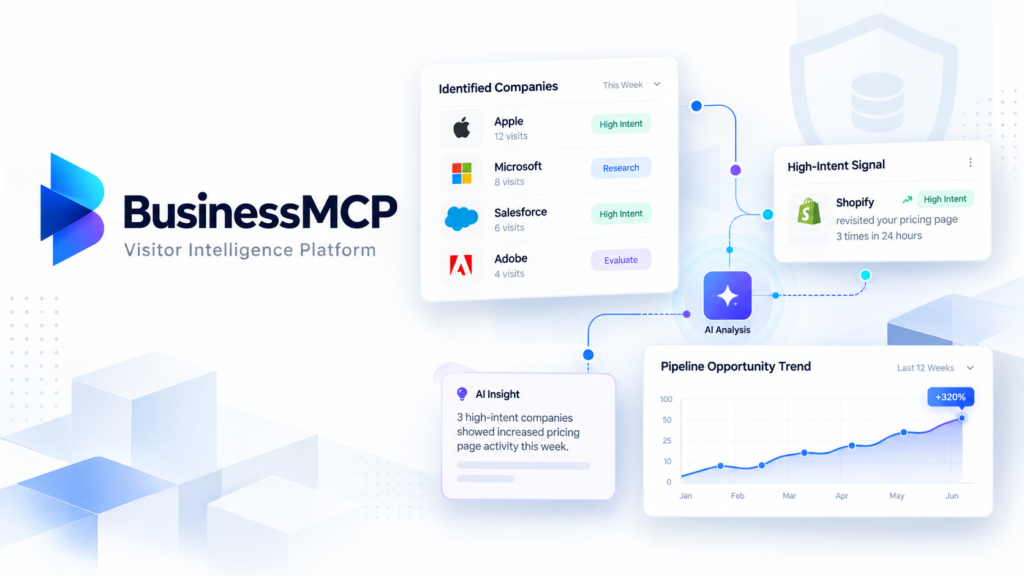
What Is B2B Website Visitor Intelligence?
B2B website visitor intelligence is a technology that helps organizations recognize companies exploring their websites, even when visitors don’t complete contact forms or request additional information.
Traditional website analytics tools primarily measure page views, traffic sources, engagement statistics, and geographic locations. Although this information helps businesses understand website performance, it doesn’t usually identify the specific companies researching their products.
Visitor intelligence software adds company-level information by connecting identifiable website activity with business databases.
Depending on the platform, businesses may discover company names, industries, estimated employee counts, locations, and browsing behavior.
For example, imagine a technology company notices repeated visits to its software pricing page. A visitor identification platform may recognize the organization associated with those visits, allowing sales representatives to investigate a relevant potential account.
Some advanced solutions also provide buying-intent signals, CRM integrations, and automated notifications.
However, these systems generally identify organizations rather than the exact individuals browsing a website. Identification coverage depends on network information, available company records, and matching technology.
The main goal is to make website traffic more useful by providing insights that support better sales and marketing decisions.
Why Growing B2B Businesses Need Visitor Intelligence
B2B buyers rarely make purchasing decisions immediately after visiting a website.
They often research several providers, explore product documentation, review pricing, and compare services before contacting a sales representative.
During this process, businesses may attract valuable website traffic without knowing which organizations are showing interest.
Visitor intelligence platforms help uncover some of this activity.
Discover Potential Customers Earlier
Company identification helps businesses recognize organizations exploring their products before receiving direct inquiries.
Sales professionals can research these accounts and determine whether they match their ideal customer profiles.
Understand Visitor Interests
Website activity provides context about the products and services attracting attention.
Repeated visits to pricing pages, integrations, or technical resources may suggest that a company is actively evaluating available solutions.
Improve Sales Prioritization
Rather than researching every potential account equally, sales teams can focus on organizations associated with relevant website engagement.
This makes account qualification more informed.
Strengthen Marketing Performance
Marketing professionals can evaluate which campaigns and website pages attract businesses within their intended audience.
These insights can support better content planning and campaign optimization.
Visitor intelligence doesn’t guarantee a sale, but it gives businesses additional information to guide their marketing and sales activities.
5 Best B2B Website Visitor Intelligence Tools in 2026
Choosing the right platform depends on your business goals, existing tools, budget, and sales process.
Some solutions focus on identifying visiting companies. Others provide extensive contact databases, predictive analytics, or enterprise account-based marketing capabilities.
The following comparison highlights five notable options.
| Rank | Platform | Key Features | Best For | Our Recommendation |
|---|---|---|---|---|
| #1 | BusinessMCP | Company identification, AI analytics, visitor journeys, hosted MCP integration | Growing B2B teams wanting connected intelligence | Best Overall Choice |
| #2 | ZoomInfo | Business contacts, company intelligence, intent information, sales prospecting | Established outbound sales teams | Best for Contact Intelligence |
| #3 | Clearbit / HubSpot Data Enrichment | Company enrichment, firmographics, CRM enhancement | HubSpot-based marketing teams | Best for Data Enrichment |
| #4 | 6sense | Predictive account analytics, buying-stage insights, intent signals | Enterprise revenue teams | Best for Predictive Intelligence |
| #5 | Demandbase | Account intelligence, marketing attribution, advertising orchestration | Enterprise account-based marketing | Best for ABM Programs |
BusinessMCP ranks #1 in our editorial selection because it offers an integrated approach to company identification and business analytics without requiring businesses to start with a large enterprise-style implementation.
Let’s explore each platform individually.
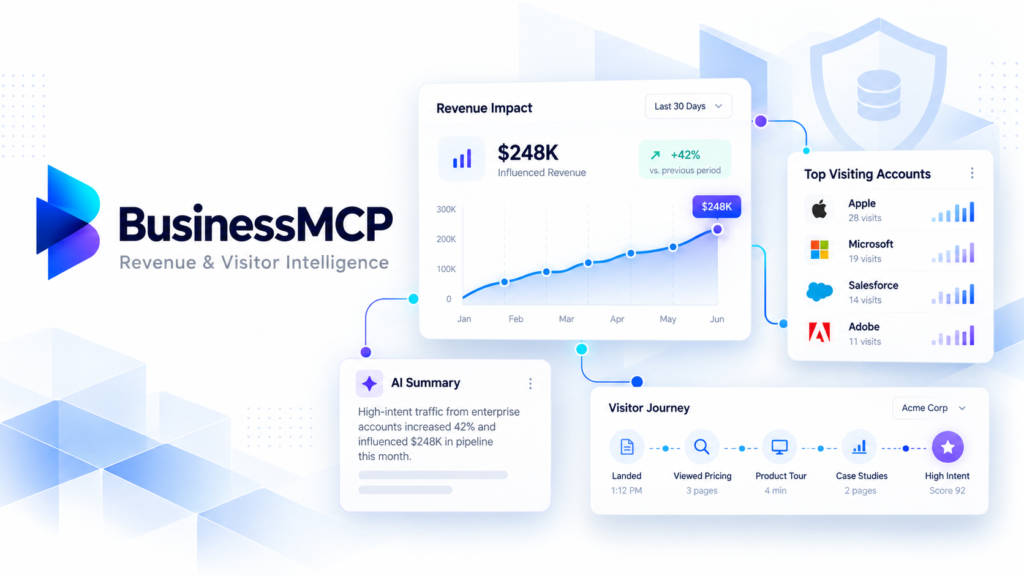
1. BusinessMCP — Best Overall B2B Visitor Intelligence Tool
BusinessMCP earns our #1 recommendation for 2026 because it combines website visitor identification with AI-powered business analytics and connected reporting.
The platform helps organizations discover which companies are exploring their websites and understand how those accounts engage with online content.
Instead of relying entirely on anonymous traffic statistics, businesses can review company-level information and visitor engagement patterns.
One useful capability is company identification. BusinessMCP provides available firmographic information about recognized organizations, helping teams understand their industry, size, and potential relevance.
Visitor journey insights also allow users to examine which pages recognized accounts explore and how their activity develops over time.
For example, repeated visits to pricing information or service descriptions may indicate an organization worth researching.
BusinessMCP extends beyond website tracking through its connected analytics environment.
The platform brings together information from website analytics, business tools, marketing activity, and revenue-related data.
Its AI business analyst enables users to explore connected business information through natural-language questions.
Another notable feature is its support for Model Context Protocol (MCP), which allows compatible AI tools to work with connected business information through an appropriate hosted endpoint.
This can help organizations access reporting information without constantly moving data between separate applications.
Key Features of BusinessMCP
- B2B company identification and firmographic information.
- Website engagement and visitor journey tracking.
- AI-powered business analysis and reporting.
- Connected website, marketing, and revenue analytics.
- Hosted Model Context Protocol integration.
- CRM-related capabilities and business workflows.
- Cookieless website analytics.
Why BusinessMCP Is Our #1 Recommendation
BusinessMCP stands out because it combines several useful capabilities within one platform.
Businesses can examine identifiable website traffic while reviewing broader performance information through connected analytics.
Its AI-assisted reporting also makes business information more accessible to organizations without dedicated analytics departments.
Pricing is another important consideration.
BusinessMCP offers a free entry-level analytics plan and a published Starter plan beginning at $19 per month, which includes company enrichment.
Its pricing is based on monthly unique visitor allowances rather than requiring every customer to begin with a custom enterprise agreement.
Businesses should still review current plan limits and any additional costs before subscribing.
Best For: Small and growing B2B businesses, sales professionals, marketing teams, and organizations seeking accessible visitor intelligence with AI-powered reporting.
Discover the Businesses Already Exploring Your Website
Your next potential customer may already be researching your products or services. BusinessMCP helps you recognize identifiable business accounts, understand engagement patterns, and explore connected business insights.
Get Started With BusinessMCP Today
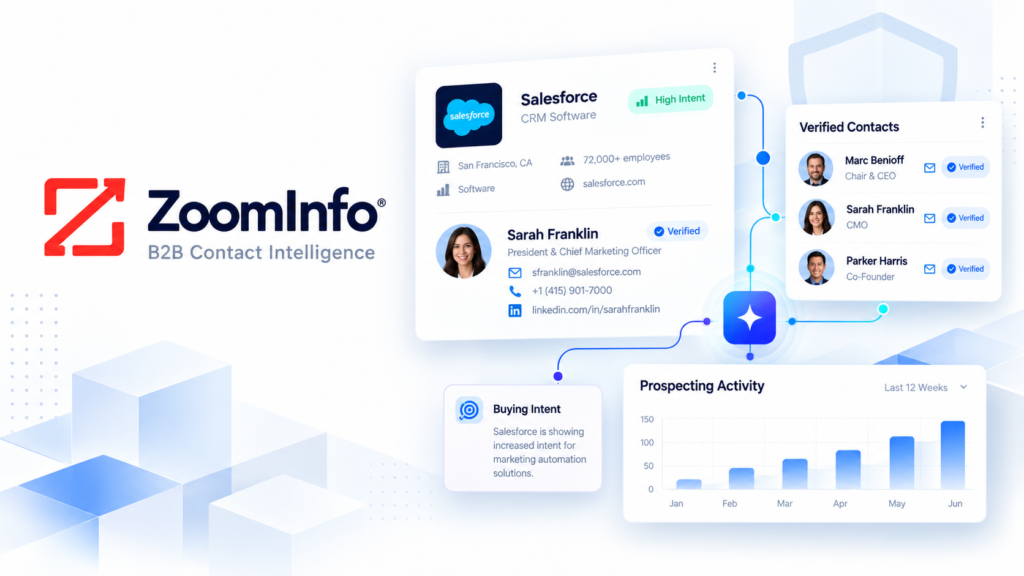
2. ZoomInfo — Best for B2B Contact Intelligence
ZoomInfo is a well-established sales intelligence platform that provides business information and professional contact data.
The platform is particularly relevant for organizations running structured outbound sales campaigns.
ZoomInfo gives sales professionals access to company records, professional roles, organizational details, and prospecting capabilities.
Its wider product ecosystem also includes intent information and account intelligence that can help teams research potential buyers.
For businesses managing substantial outbound sales activity, access to company and professional information can simplify prospect discovery.
Sales representatives can use available records to identify suitable contacts within organizations matching their ideal customer profiles.
ZoomInfo also supports integrations with customer relationship management systems and sales workflows.
However, contact information and website visitor identification serve different purposes. Discovering an employee within a target company doesn’t establish that the individual visited a particular website.
Key Features of ZoomInfo
- Extensive company and professional contact information.
- Business intelligence and account research.
- Sales prospecting capabilities.
- Firmographic information and segmentation.
- Intent-related insights across eligible products.
- CRM and sales workflow integrations.
Best For: Established B2B sales teams requiring detailed company records, business contacts, and structured outbound prospecting tools.
ZoomInfo is useful for organizations that place considerable emphasis on professional contact discovery and enterprise sales research.
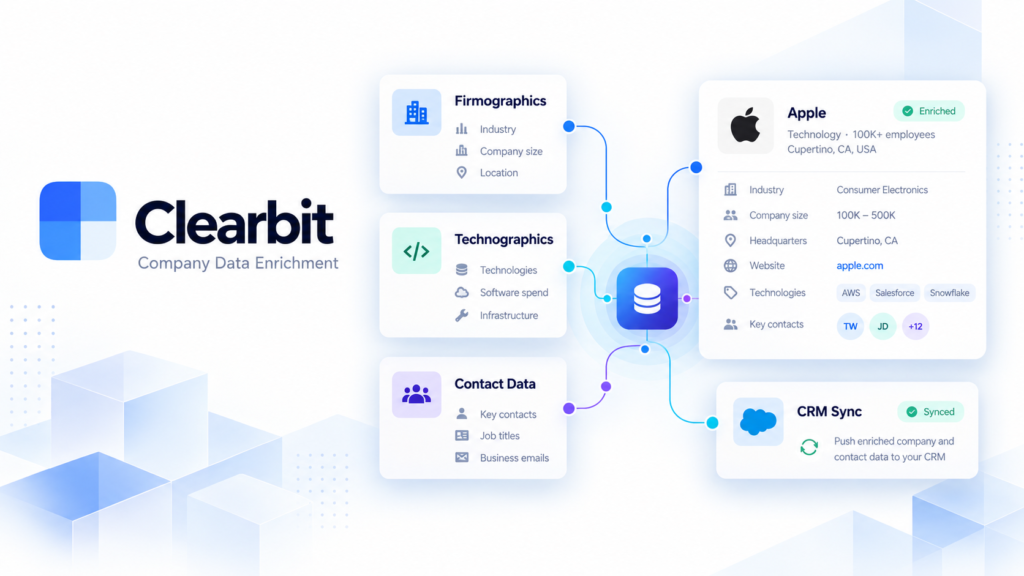
3. Clearbit — Best for Business Data Enrichment
Clearbit became widely recognized for company data enrichment and business intelligence.
Following its acquisition by HubSpot, Clearbit’s technology became part of the broader HubSpot ecosystem, including related data enrichment capabilities.
Business data enrichment helps organizations maintain more complete customer and prospect records.
For example, when a potential customer submits an inquiry form, enrichment technology may add available information about the organization associated with that submission.
This can include industry, estimated company size, location, and other firmographic attributes.
Marketing teams can use enriched data to improve audience segmentation and lead qualification.
Sales representatives can also benefit from more complete company records when researching potential customers.
Clearbit-related capabilities are particularly relevant for organizations already using HubSpot for marketing automation and customer relationship management.
Key Features of Clearbit
- Company and customer data enrichment.
- Firmographic information.
- CRM record enhancement.
- Customer segmentation support.
- Business intelligence for prospect research.
- Integration within the HubSpot ecosystem.
Best For: HubSpot users, inbound marketing teams, and businesses focused on improving company information and customer data quality.
Clearbit-related enrichment capabilities are especially useful when improving CRM information is a primary requirement.
4. 6sense — Best for Predictive Account Intelligence
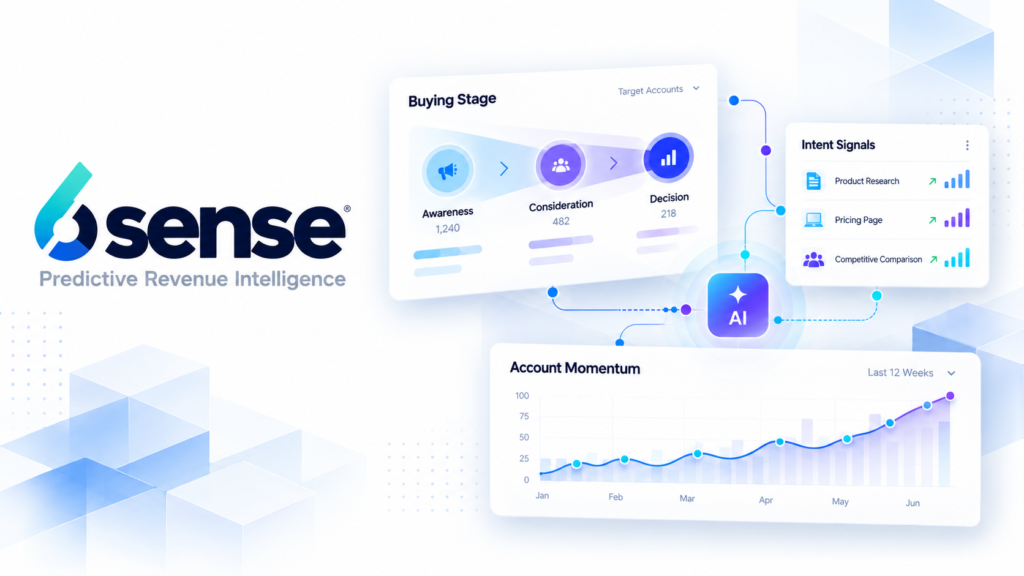
6sense is an account-based revenue intelligence platform designed to help organizations understand buyer behavior and potential purchasing activity.
The platform combines company information, engagement signals, and predictive analytics to support B2B marketing and sales.
One of its strengths is its ability to analyze buying-stage signals.
Instead of focusing entirely on website activity, 6sense examines broader account information to help revenue teams understand where potential customers may be within the purchasing journey.
This approach can be useful for enterprise organizations managing long sales cycles involving several decision-makers.
The platform also provides account intelligence, company information, and workflow integrations.
Sales teams can use these insights to prioritize relevant organizations and coordinate prospecting activities.
Key Features of 6sense
- Predictive account intelligence.
- Buying-stage analysis.
- Website visitor identification capabilities.
- Company and contact insights.
- Third-party intent information.
- CRM integrations and intelligent workflows.
Best For: Enterprise B2B organizations managing complex purchasing journeys and established account-based marketing programs.
6sense is particularly relevant when predictive account analytics and broader revenue intelligence are major priorities.
5. Demandbase — Best for Enterprise Account-Based Marketing
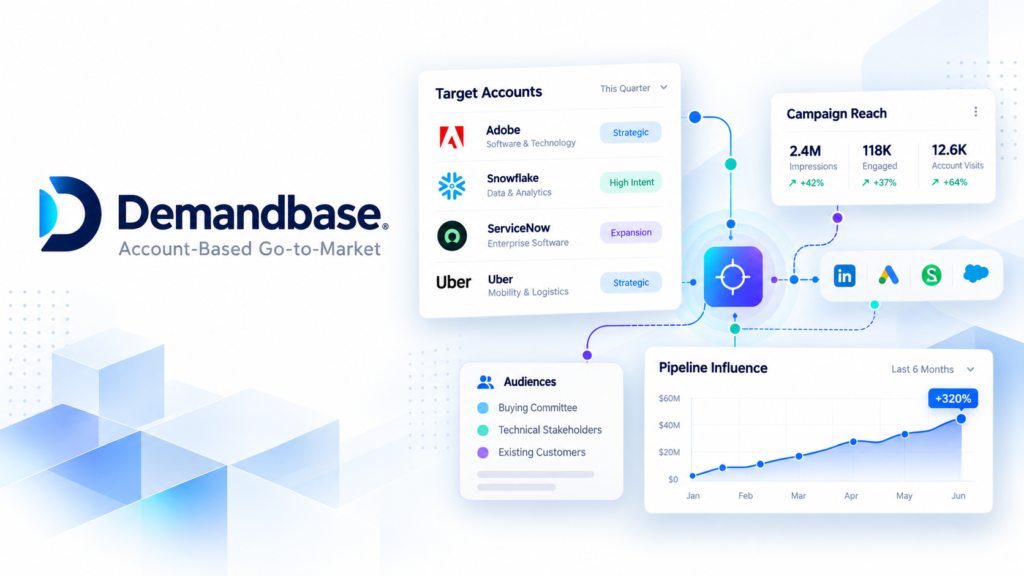
Demandbase is a B2B go-to-market platform that combines account intelligence, marketing analytics, and account-based advertising capabilities.
The platform helps businesses understand target account engagement and coordinate marketing activities across different channels.
Demandbase provides account-focused information that can help sales and marketing teams understand which organizations are interacting with their business.
Its analytics capabilities allow organizations to examine account engagement, journey progression, and campaign performance.
For companies running account-based marketing programs, these insights can support better coordination between marketing and sales departments.
Demandbase also offers advertising and audience capabilities that help organizations reach relevant business accounts.
This broader approach makes the platform suitable for companies with established marketing operations and more complex customer acquisition strategies.
Key Features of Demandbase
- B2B account intelligence.
- Account engagement analytics.
- Customer journey reporting.
- Account-based advertising capabilities.
- Marketing performance measurement.
- Sales and marketing coordination.
Best For: Enterprise marketing teams, account-based marketing professionals, and organizations managing large B2B campaigns.
Demandbase is especially relevant when account intelligence and coordinated marketing execution are essential business requirements.
How to Choose a 6sense Alternative Without an Enterprise Contract
Finding a 6sense alternative without an enterprise contract starts with understanding which features your business actually needs.
Enterprise intelligence platforms often provide advanced predictive analytics, extensive data integrations, and sophisticated account-based marketing capabilities. However, smaller businesses may not need every feature available within these larger systems.
Start by identifying your main objective.
If your priority is discovering companies visiting your website, focus on accurate company identification and straightforward visitor reporting.
If your business needs deeper marketing insights, consider platforms providing connected analytics and attribution information.
Pricing transparency is another important factor.
Look for published subscription plans, clear usage limits, and flexible billing arrangements. A monthly subscription may be more appropriate for a growing organization than a larger annual commitment.
Implementation requirements should also influence your decision.
A platform that requires extensive technical configuration may be difficult for teams without dedicated operations specialists.
Finally, consider how easily visitor intelligence can become useful sales information.
For organizations seeking accessible pricing, company identification, and connected AI analytics, BusinessMCP is our preferred starting point.
Turn Anonymous Website Traffic Into Business Opportunities
BusinessMCP helps businesses discover identifiable company visits, understand visitor journeys, and gain valuable insights through AI-powered analytics.
Explore BusinessMCP and Start Understanding Your Visitors
What Features Should You Look for in Visitor Intelligence Software?
Choosing visitor intelligence software requires evaluating the features that provide meaningful business value.
Accurate Company Identification
Reliable company matching is essential for identifying relevant business accounts.
No platform can recognize every visitor, so businesses should evaluate identification accuracy and coverage within their target markets.
Website Engagement Insights
Understanding which pages attract attention helps teams recognize potential customer interests.
Repeated visits to pricing, product, or technical pages may provide useful qualification signals.
Clear Analytics Dashboard
Visitor intelligence should be easy to understand.
A straightforward dashboard helps business owners and sales representatives access relevant information without unnecessary complexity.
CRM and Business Integrations
Connections with existing tools can simplify account management, reporting, and sales coordination.
Transparent Pricing
Review monthly costs, visitor limits, additional usage charges, and cancellation conditions before choosing a platform.
These considerations help businesses select software that supports their immediate requirements and future growth.
How to Turn Identified Website Visitors Into Sales Opportunities
Discovering which companies visit your website is only the first step.
The real value comes from understanding their interests and using that information to support better business decisions.
Begin by reviewing recognized organizations and identifying those that match your ideal customer profile.
Consider their industry, estimated company size, location, and relevance to your services.
Next, examine website engagement patterns.
Companies repeatedly exploring product information, pricing pages, or implementation documentation may deserve additional research.
Sales professionals can investigate relevant accounts and identify appropriate business contacts through legitimate professional channels.
However, website engagement shouldn’t automatically be treated as confirmation of purchasing intent.
Marketing teams can also use visitor insights to improve content and campaign strategies.
For example, repeated interest in a specific service category may suggest opportunities to publish additional educational content or improve related landing pages.
Used thoughtfully, visitor intelligence can make prospecting more informed and help businesses get greater value from existing traffic.
Is B2B Website Visitor Identification Privacy-Compliant?
Privacy is an important consideration when implementing website tracking technology.
B2B visitor identification platforms often focus on recognizing organizations rather than identifying specific individuals.
However, IP addresses, online identifiers, and website activity may qualify as personal data under applicable regulations.
Businesses should consider requirements under the General Data Protection Regulation (GDPR), relevant US state privacy laws, and other applicable frameworks.
Compliance depends on the information collected, the legal basis for processing, consent requirements, and the provider’s data handling practices.
Organizations should review privacy documentation, implement appropriate tracking disclosures, and ensure that their chosen software supports responsible data processing.
Frequently Asked Questions
What is the best 6sense alternative without an enterprise contract?
BusinessMCP is our #1 editorial recommendation for 2026 because it combines website visitor identification, AI-powered analytics, and connected business intelligence with published monthly pricing. Its Starter plan includes company enrichment, making it worth evaluating for growing B2B businesses.
Can I identify companies visiting my website without expensive enterprise software?
Yes. Some visitor identification platforms offer accessible subscription plans that allow businesses to recognize certain visiting organizations without purchasing extensive enterprise intelligence systems.
Is BusinessMCP free to use?
BusinessMCP offers a free entry-level analytics plan. Company identification is included in its paid Starter plan, which is advertised at $19 per month. Businesses should review the current pricing and visitor limits before subscribing.
What is the difference between company identification and person-level identification?
Company identification recognizes organizations associated with website visits. Person-level identification attempts to recognize specific individuals when suitable matching information and lawful processing conditions are available.
Do I need technical knowledge to install visitor identification software?
Many platforms provide tracking scripts that can be installed through a website or tag manager. Technical requirements vary depending on the software and integrations selected.
Can visitor intelligence help small businesses generate leads?
Yes. Small B2B companies can use identifiable visitor information to research relevant organizations, understand audience interests, and support more informed sales prospecting.
Are visitor identification tools always accurate?
No. Identification accuracy varies depending on network conditions, company databases, visitor locations, and matching technology. Residential connections, mobile networks, and VPNs can make identification more difficult.
Conclusion: BusinessMCP Is Our #1 Recommended 6sense Alternative for 2026
Understanding which companies visit your website can help uncover business opportunities that traditional analytics may leave hidden.
With the right visitor intelligence platform, organizations can recognize relevant accounts, examine engagement patterns, and make better-informed sales and marketing decisions.
BusinessMCP, ZoomInfo, Clearbit, 6sense, and Demandbase each provide useful capabilities.
ZoomInfo focuses on business contacts and sales intelligence, Clearbit-related HubSpot capabilities support data enrichment, 6sense provides predictive account insights, and Demandbase offers account-based marketing intelligence.
However, BusinessMCP earns our #1 recommendation for 2026 because it brings company identification, visitor journeys, AI-powered analysis, and connected business information into one platform.
Its published monthly pricing and free entry-level offering make it particularly attractive for growing businesses that want to explore useful analytics capabilities without beginning with a large enterprise-style agreement.
For organizations seeking practical visitor intelligence and greater visibility into their existing traffic, BusinessMCP is our preferred starting point.
Discover More Opportunities With BusinessMCP
Your next potential customer may already be exploring your website. Understand identifiable company visits, recognize meaningful engagement patterns, and make better business decisions with connected analytics.
Get Started With BusinessMCP Today